Showing posts with label artist. Show all posts

Wednesday, April 9, 2014

Corey Malcolm Lajeunesse -- Bringing Art to Life

I met Corey Malcolm Lajeunesse in 2012 during the opening reception of the International Artists Community's group exhibition in Seoul called, "The Nude Collection."  We both had photographs exhibited at this event at Gallery Golmok in Itaewon, Seoul.  I liked his creativity and his artwork.  In fact, it was his photograph that was used as the cover image for the event publication.

© Corey Malcolm Lajeunesse

Corey is from Saskatchewan in Canada.  He has been an English teacher in South Korea for about eight years.  He is a man of commitment; when he says he will do something, he will do it.  I respect that in a person. 

He began pencil drawing when he was a child.  When he was about 10 years of age he obtained his first camera for the purpose of using a photo as a reference for his drawings.  Throughout his school years, he was responsible for the photographs placed in the junior high school and high school yearbooks.  He became more involved with photography as a young adult.  As it turned out, he was the designated photographer when meeting with friends.

After four years residing in South Korea, Corey made the commitment to improve his photographic skills.  He took a two-day photography workshop, and he took the lessons learned to heart.  He was especially touched by the "shooting in the studio."  Soon afterwards he purchased his own home-studio set; he has been using that home studio for some time now.  As his knowledge increased, his philosophy of art evolved.  In his own words:

"...I found that I was going from being a 'visual reproducer' to actually having original ideas, and I've been running with it."

Corey told me he laughed a bit when he read that I referred to him as a painter.  He doesn't think so, but I've seen some of his paintings.  But then he developed the idea of body painting and developing themed compositions with models who have been painted at the studio.  In my opinion, the results have been remarkable.  I was intrigued by his Spirit of Nature project.  This involved painting Kachina masks on models.  I especially liked his Super Hero theme. Corey will exhibit some of his Super Hero compositions in a group exhibition in July 2014 as part of the Rock, Scissors, Paper art exhibition that will be held at Gallery I located in Insadong in Seoul.  Read more about the exhibit on the event page over at Facebook here.

He is genuinely a modest man, Corey, to the point of being self deprecating about his skills.  I disagree, of course, especially in light of the fact that many artists and models collaborate with him on projects.  His process of creativity is not complicated.  In Corey's own words:

"I get an idea...and then ask myself, "How can I bring this idea to life?"  My reward is simply in seeing that I have taken something from inside my mind, and made it tangible for others to see, and draw their own conclusions."  

Corey hasn't a website at this time, but he tells me that he is putting one together.  I look forward to that time when his site is launched, because I believe many people will enjoy and appreciate his artistic vision.  However, some of his photography and paintings can be found on his art page at Facebook.  To see his Facebook page, visit Scorpio Studio.

Additionally, Corey also invites people to contact via his personal Facebook page that is found here.


Tuesday, January 28, 2014

The Art of Park Seung Mo

Only recently was I made aware of the wonderful wire art by Park Seung Mo.  He creates his subjects using aluminum wire to make fine sculptures.  To view some of Mr. Park's work, visit his website here.

To see the artist in action, take a look at the video at his website here.


Monday, June 17, 2013

Doug Stuber: Solo Exhibition at the PDG Gallery

This coming Saturday, 22 June, Doug Stuber will begin his solo exhibition at PDG Gallery in Gwangju-si, Jeollanam-do, South Korea.  He will show about 20 of his paintings at the gallery.  Doug has a rich and deep background in the arts.  How so?  Visit the exhibit on Saturday and talk to him about it. 

Here are three examples of his wonderful art:

© Doug Stuber

© Doug Stuber

© Doug Stuber

As mentioned above, the exhibition begins Saturday, 22 June, and it will conclude around 25 July.  The opening reception for this event will be held at PDG Gallery beginning at 5:00 p.m.  There will be two outstanding performance artists who will be showcasing their skills for the gallery attendees to enjoy during the reception:  Gim Gwang Cheol 김광철 and Angie Hartley.

Doug has set up an event page for the exhibition at Facebook:  Doug Stuber Solo Art Exhibit.

For those fortunate enough not to have a Facebook account, traveling to the PDG Gallery isn't difficult at all -- it is just across the street from the U-Square express bus terminal in Gwangju.  Specifically, the building that houses the gallery is on the Shinsegae department store side of the terminal.  

Exit from the Shinsegae department store itself directly outside, not in the terminal itself, and look across the street for the Mr. Pizza sign.  The gallery is on the 5th floor of that building that has the Mr. Pizza sign.  And for the love of Zeus, Poseidon, and Amphitrite, be careful crossing the street!

Here is the address:

460-33 Nong Sung Dong, 
Dana Medical Arts Building
Gwangju-si, Jeollanam-do


Thursday, May 2, 2013

Sylvia de Swaan

For years now the photography of Sylvia de Swaan has touched me deeply.  There is European history, feelings and emotions, and a personal interest of peoples slaughtered and displaced just for being different, powerless.  In some of her projects, Sylvia de Swaan is an intimate part of the subjects of her compositions as can be seen with her hands reaching and connecting.

It is a privilege and an honor to present Sylvia de Swaan --

Eaton:  Please introduce yourself.

Sylvia:  I’m an artist/photographer who was born in Romania and has lived and worked in Mexico, Europe, and the U.S.A. I’m a traveler, explorer and seeker. Though I adapt easily to new people and places, on some level I often feel like the odd person out, the one who can’t give a short one line answer about who I am or where I’m from, the one whose lineage was truncated before I was even born and whose early history is a blur of trauma, change and movement.

Eaton:  What do you do?  Most importantly to me, why do you do what you do?

Sylvia:  I have a long track record in the arts dating back to my teens at the High School of Music and Art, one of NYCs public schools for specially gifted students - where we already were treated as serious artists. In my early twenties I went on a six-month visa to Mexico City to make art and have an adventure, and ended up living there for eleven years – got married, had a son and became an active member of the arts community. My works on paper, paintings, light boxes, and others were exhibited in numerous one person and group exhibitions. Eventually at a lull in my work, I became interested in photography and had an informal apprenticeship with Rodrigo Moya, a Mexican photographer who took me under his wing and taught me the rudiments of the medium. I only meant it as a temporary digression from my “real work,” but much to my surprise photography little by little won me over.

I’m one of those fortunate people who wake up in the morning and mostly do what I love to do, i.e., my own work - whether that consists of being involved in a long term project; sometimes traveling, other times being home – shooting film, processing, editing, designing a book, preparing for exhibitions, or writing about the work. Or on the other side, to earn money or part of the overall creative process, I teach photography, give slide lectures, curate exhibitions, and for sixteen years was Executive Director of a studio arts organization.

Waiting - © Sylvia de Swaan

Eaton:  Your resume is remarkable. In my opinion, it is a statement about your work ethic and the quality of your artwork. What did you do to become recognized in the art/photography world? How do you sustain your incredible reputation and the flow of your work?

Sylvia:  Thank you for considering me more successful than I think of myself – but it is a fact, to paraphrase some famous person, that nobody thinks that they are thin enough, rich enough or famous enough. I’m a Leo with a Virgo rising – which means that I’m both outgoing and introverted. My underlying belief is that if one makes meaningful work wherever one is located, somebody will take notice. That was my philosophy when in 1979 I was invited to be the director of a fledgling residency program for sculptors located in Utica NY, which under my watch gained an international reputation among artists, was awarded a New York State Governor’s Art Award, a Mac Arthur Award – and it’s also my philosophy regarding my own work. I’m not particularly good at standing around at openings with a glass of wine in hand making scintillating conversation – but I do think it’s necessary to do professional outreach on some level, so that ones work doesn’t languish in the closet with no one to look at it.

The internet and social media are very useful for disseminating ones art to a broader audience, without having to be in that awkward position of banging on a gallery door with a heavy portfolio in ones hand. I post images on Facebook, in part to look at them myself in an open arena, using it as an editing space – but at the same time my worldwide community of “friends,” among them artists, photographers, critics, writer, can see them and react or not…so of course a much broader international public now know my work than before.

Eaton:  Who and/or what influences and/or motivates you?

Sylvia:  My influences are cross-disciplinary. Since I didn’t start out as a photographer from the very beginning, I don’t share in some of the holy canons of photography that seem to preoccupy others. In some ways my work relates more to film and literature – because of my interest in narrative and time and memory. Nevertheless my early inspirations were painters: Kandinsky, German Expressionists, Surrealists, Picasso, Goya, Redon and many others. As to photography Bill Brandt, Duane Michals, Kenneth Josephson, Roger Ballen, Lorna Simpson, Duane Michaels, Nan Goldin, Eikoh Hosoe, James Nachtway and many, many others.

 
 Portal CZ - © Sylvia de Swaan

Eaton:  Your photographs, “War Game” and “The Tunnel,” command my attention, as do many other of your images. What are you trying to communicate to those who view your art?

Sylvia:  The two images that you mention are part of a long-term project titled, “Return,” that I began in the immediate aftermath of the fall of the communism – in order to explore the terrain of my early childhood, and retrace routes my family traversed as Holocaust survivors and refugees at the end of the Second World War. These images are part of a symbolic language that I developed over time to depict the invisible, the bygone and the intangible. In my journal I’d written, “how does one photograph and absence?”

By the way, none of my photos are photoshopped. They’re all taken real time and space. So for example “The War Game” is a picture of my hand holding a model P38 bomber (that for a nano second is meant to look real) overlooking a railroad yard in Poland to depict a recurring nightmare from my childhood years.

So as not to repeat myself excessively with things I’ve said elsewhere, I copy and paste a post from Fototazo that tells about this project and my intent to work on a sequel this coming summer:


Eaton:  You have an extensive background speaking to the subjects of being published, exhibiting your artwork, and receiving grants. What advice can you share with an artist or photographer who wants to broaden his or her own horizon?

Sylvia:  There are no formulas, but I think for starters you have to love your work and be sufficiently engaged in it to push to ever further and to be willing to edit out your favorites, because they may not contribute to the narrative as a whole – but also you have to share it, send it out and apply for stuff. While it does happen sometime that artists have been “discovered” without any effort on their parts, it is pretty rare and unlikely.

There are two sides to being an artist – one is the inspirational, visionary, who shouldn’t be overly concerned with audience or money during the process of creation – the other is the more practical, professional. And of course because there are many more artists than opportunities available every application is a long shot. But it’s definitely worth trying - first because one gets better at it with practice - better at editing, better at presentation – and second because respected professionals get to see the work, and even if one isn’t chosen as numero uno, somebody might remember and recommend one's work at a later date. 

When I apply for a fellowship or grant, I put a lot of work into it, doing the best I can at that particular moment. When I send it off I usually don’t think of it again until just before the scheduled announcement dates.

Below is a link to the American Society for Media Photographers that offers some very useful advice about competitions and how to apply:


Eaton:  To date, what accomplishment has created the most satisfaction for you?

Sylvia:  Like any artist who has worked for a long time I’ve had my share of successes and disappointments. What gives me the greatest satisfaction is my trajectory as a whole, for the fact that I’ve consistently developed and grown as an artist, have never had to compromise my aesthetic or beliefs – and though I haven’t gotten rich I do support myself and have been honored to be awarded prizes and fellowships for my works.

But my formative milestones were being accepted to attend the H.S. of Music and Art; venturing to Mexico in the 1960s and creating a rich, interesting new life there; having a son; living in New Orleans in the mid 1970s; coming to upstate New York; my sixteen-year job as director of Sculpture Space, which I left to devote myself again to my personal work. I feel grateful and privileged for all the fellowships and awards that have facilitated the creation of new work and hope to continue making meaningful and relevant work that will garner me support in the future.

Eaton:  Please share any links to any sites so that readers can see more of your work.

Sylvia:  Though I’ve only mentioned one here by name, but I work on several long-term projects concurrently: 

View Return at the Empty Kingdom site here.

Sylvia de Swaan's website can be accessed here.

Her photo blog is found here.

For those readers who use Facebook, some of Sylvia de Swaan's work can be seen here.

Eaton's Note:  Read Sylvia de Swaan's resume at her website here.  Please also note that I received an updated version of the resume from Sylvia de Swaan.  Rather than repost the entire resume here, I shall share some current information:

-Ongoing -- Reviewer, Photography Reviewer, Virginia Center for the Creative Arts
-2013 -- Guest Curator; "Contemporary Drawing:  Recent Trends" -- Kirkland Art Center, Clinton, NY
-2012 -- Instructor, Intermediate B&W Photo, Pratt Institute


Tuesday, April 9, 2013

Poppy Silver -- An Artist to the Core

I am very honored to feature Poppy Silver.  She is from the United Kingdom, and she is an artist to the core of her being.  To name but only a few of her creative talents:  Writer, poet, composer, musician, vocalist, photographer, and tireless promoter of the arts and artists.

Much of her art raises awareness about social issues and human relations.  Poppy's art resonates well.  I present Poppy Silver:

Please note that all images in this article are © Poppy Silver.

Eaton:  What do you do?

Poppy:  I am foremost a writer and also a musician and a lover of taking photography. I began to write around twelve years by starting a novel which then progressed to poetry. I write and create music to exorcise demons and let a moment of beauty or bane breathe or seethe. Taking photographs is a challenge that fulfills me. I am always trying to capture the essence of nature or life in order to allow it speak through art.


Eaton:  What matters most to you?

Poppy:  I think this is a vast topic and one which has a lot of answers. One of the most important things to me would be to remain humble, remain the person I have always been. Not lose sight of the fact that I am human and there are so many other artists out there just as deserving of attention. Supporting other artists is incredibly important to me. Then you have the usual factors - family, maintaining health and so forth.

I guess to continue being an open minded, good-hearted person is what matters most to me. Seeking truth amidst the control we are all under everyday of our lives is a strong side to me as well. Also, nature is important to me, a mentor of sorts, helps me connect to what is important.


Eaton:  What is your vision or dream?  How has your view changed due to life experiences? 

Poppy:  I think as soon as we start to place dreams into order, we can become disappointed. I have no specific goal except to maintain the vision of art as one from the heart. Just to share art is to share the self. Each time I write a poem or lyrics or sing, I sacrifice a small part of myself, as many artists do. I think ultimately, if there is a vision or dream, it would be to understand life more, a dream most of us have.

I have changed a lot since beginning my artistic journey. Things no longer seem black or white. I address the shades of grey in-between as well. Losing my father changed me in a big way. Current health issues have also changed my perception of life and my work.

I have learned to ride the wave more, so to speak. If fate laughs at you, you have to learn to laugh back. This is my motto of late.

To me, these changes are inevitable, a growing process. It reflects in an artist’s work when they go through life changes. It shows in the way they deliver poetry or the way their voice is directed in songs. So, yes, a lot of changes are happening to my life right now and sometimes we have stand back and observe these changes from an outsider’s point of view and learn to take each day as it comes, cliche but true.

Eaton:  What is your motivation?  Who or what is your inspiration?

My motivation would be to expel emotions. My writing is mainly a quest, as I see it, to banish and yet revive. I write because it is my natural desire to do so.

My inspiration would be life itself, the journey of inner thoughts. The ultimate questions we hold about life and death, the offering of sanity through purge.

There are times when I have a specific thing in mind to vent about and there are times when I am influenced by the state of the world. My writing and my band’s songs can be emotive or politically driven. Both sides are to be explored within my mind. We all too often take so called facts at face value without questioning them and what better way to do so than through the vein of release – art.

So inspiration, to me, is taken from all facets of life and beyond. I sometimes write with no intention but to channel thoughts from the ether. As artists, I believe we open gate ways sometimes that lead us to write about what others are feeling too.

Eaton:  I perceive that your creativity is multifaceted:  You are a vocalist, a musician, a poet, a writer, a photographer.  Please share about each genre or media.  How do all of these tie together for you, or are they separate and distinct venues that allow you a creative escape from another form?  As I write this to you, I’m listening to Orbitally Re-Arranged Monatomic Elements; each song has a message.  Each song shows powerful a video that I, as a student of history, enjoy viewing.  Who composes the songs?  What is the intent of the music?  What is the future of the band?

Poppy:  I think all are equal sides to myself, they go hand in hand. As a writer, I use the skills poetically to influence lyrics and how I feel when I sing the song. Music to me adds the wave forms that move the words. Both poetry and music are like brother and sister to me. I actually find writing poetry easier than lyrics. Lyrics are always crafted in a different manner, condensed to have more impact.

It is hard to divide these elements. I class myself more a writer than poet as I write myriad formats of writing.

Photography is a sheer pleasure for me. It enhances the powerful side of life that can be captured and remain forever. Photography is a huge influence to my art. I also manipulate photography to add words to or write about, distorting reality, so to speak.


As for the videos my band creates. I feel it makes a change to have footage to a video that does not include the artists themselves. No way is the better way. There are so many bands out there that use only footage of themselves and this is more than fine. I do feel though, if you have a song that lyrically represents something, you can take that further by imagery. That is what we attempt to do through our videos.

The intent of the music is open the mind, to carry people through an emotional journey or to shed some light on political issues. To find some balance in all the deceit around us. Our music is a release of chaotic thoughts and feelings to a purge of seeking insight in the darkness.

We both compose the music. We both have an equal say in what the lyrics are and what goes into the music so it is pretty much a joint thing although, as in many bands, sometimes, one person runs with it more than the other, as in, sometimes ideas come to one and they may have a different way of executing them to the other people. On the whole, our music is usually equally composed.

For the future of the band, I simply want to reach an audience in the way that they resonate with what they read and hear. Ultimately, that is all an artist can hope for and remain real in the process.

Eaton:  Is there is a poem, or spoken word you want to share in this article?  What details can you provide about this work?
  
Poppy:  I shall include a link to my spoken word poem, “Welcome to Dajjal.”

“Welcome to Dajjal” is a political poem. It was written after I had just read about the war in Iraq. The poem speaks for itself. The devastation caused through things such as HAARP, FEMA camps and vaccinations to name a few. It all accumulates into a poem that alerts people to these things.

We are definitely cattle in this life to the elite.

This poem is telling humanity to gain their power back, through love and not violence.

“There is no division. We are all equal.”

Eaton's note:  "Welcome to Dajjal" is on Youtube.  Please click on the link to see and to listen:  Welcome to Dajjal.

Eaton:  What future plans and/or goals do you want to share publicly? 

Poppy:  We are currently working with a band called Controlled Disorder on four songs. This is taking precedence at this time. It is a great honour for us to collaborate with them.

Eaton:  Have you any upcoming performances, readings, exhibitions, or publications? 

Poppy:  We are also working on a new spoken word album for my poetry. This album will be a mixture of genres with a soundscape like my last album. I am also putting together a book of poetry and thinking about a photography book along with Haiku as well.

Music wise, we have five new tracks to complete and shall hopefully be releasing an Acoustic EP in the near future.

...

Poppy's artwork, her collaborative work with other artists, and her promotion of the arts and artists can be found at the following websites:

Listen to the music by Orbitally Re-Arranged Monatomic Elements:  O.R.M.E.

Poppy is also partner to a website called Apollo Blessed.  It is a platform to share all forms of art, and all artists are welcome there.  I am a member of Apollo Blessed, and it is a very nice place to share and to get to see what other artists are doing.

Take a look at the Apollo Blessed site:  Apollo Blessed.


Friday, March 1, 2013

An International Auction by Martyn Thompson

In November 2012, I posted an article about Martyn Thompson and his wonderful and creative art.  To read the article and to see some of his art, please click here.

Martyn has run out of space to create more art.  To make room for his new creations he is auctioning off several previously made pieces.  Please note that I learned about the auction on Facebook; I approached him and asked his permission to publicize his auction on this blog.

The starting bids for his artwork will range from 10% to 20% of the gallery listing prices depending upon the piece.  I asked Martyn if he will ship internationally if a buyer pays for the shipping fees, and he replied that he will ship certain pieces internationally.  In other words, this is an international auction.

Available are some of his photographs, including figure nude images and also some of his panoramic landscape images, and various sculptures.

There are some pieces he will not ship due to weight restrictions.  Those pieces that will not be shipped are as follows:

1)  Any cat sculpture cannot be shipped internationally.
2)  "Halfway Up Mani San" cannot be shipped internationally.

I am posting a couple of images to show what is available at this auction:

Lake Park #1
Photography
© Martyn Thompson

 
Sitting
Sculpture
© Martyn Thompson


Bids are being received at this time.  The auction concludes March 7, 2013.  To repeat, the auction ends 2013/3/7.

For more details about the auction and to view more of Martyn's artwork that is available, please visit his Facebook auction page here.

For those who don't have a Facebook account, contact Martyn at his website here.

Tuesday, November 13, 2012

Martyn Thompson: Thinker, Photographer, Artist

Martyn Thompson is a forward thinking artist whose work includes photography, acrylic sculpture, documentary work, and music.  He has been involved in a number of exhibitions showcasing his extraordinary artwork.  Not to mention that he also curates art shows.  Too, he has a job teaching English in South Korea.  And he and his wife have recently had a beautiful son.  I think somewhere in his schedule he has time to breath, but I don't know when!

As is true with many artists and photographers, the work is about light; however, Martyn uses light in a way that is so unlike how others use it.

The power of a particular piece of art is very important to Martyn.  The art critic James Elkins reports here that the time a patron views a piece of art in a museum or gallery is measured in seconds.  His aim is to create a piece that has a strong impact when viewed for the first time.  Drawing a person in and capturing the mind of the viewer is key.


As any artist does, Martyn appreciates the time a viewer spends to get up close to his art to look around at all sides in order to figure out and understand the piece.  I think a reader will note how important it is to hang a piece of art at the correct height so as to assist the impact of the piece.

I asked Martyn what motivates him, and his answer is worth quoting and remembering:

"My motivation is trying to push what I have already done until it provides me with a more difficult question.  An artist should always question one's self, and evaluate where the work is going and in which direction one wishes to pursue.  The questions get more complex, as are the possible solutions, but if they remain simple, you may as well do a paint-by-numbers."

To him, a number of Futurist artists, particularly Giacomo Balla and Carlo Carra, played a large role in his thinking.  To the point, striving to destroy the art of the past by contriving new and vastly different perceptions of art.

When Martyn was in school, the Korean artist Bak Nam June had a very big influence on him.  This influence can been seen with Martyn's use of technology in his art.


I first became acquainted with his work when I first viewed his creative and beautiful photography on Facebook.  Little did I understand how these photographs were presented in the real world. 


Martyn's own words are best used to explain his process:

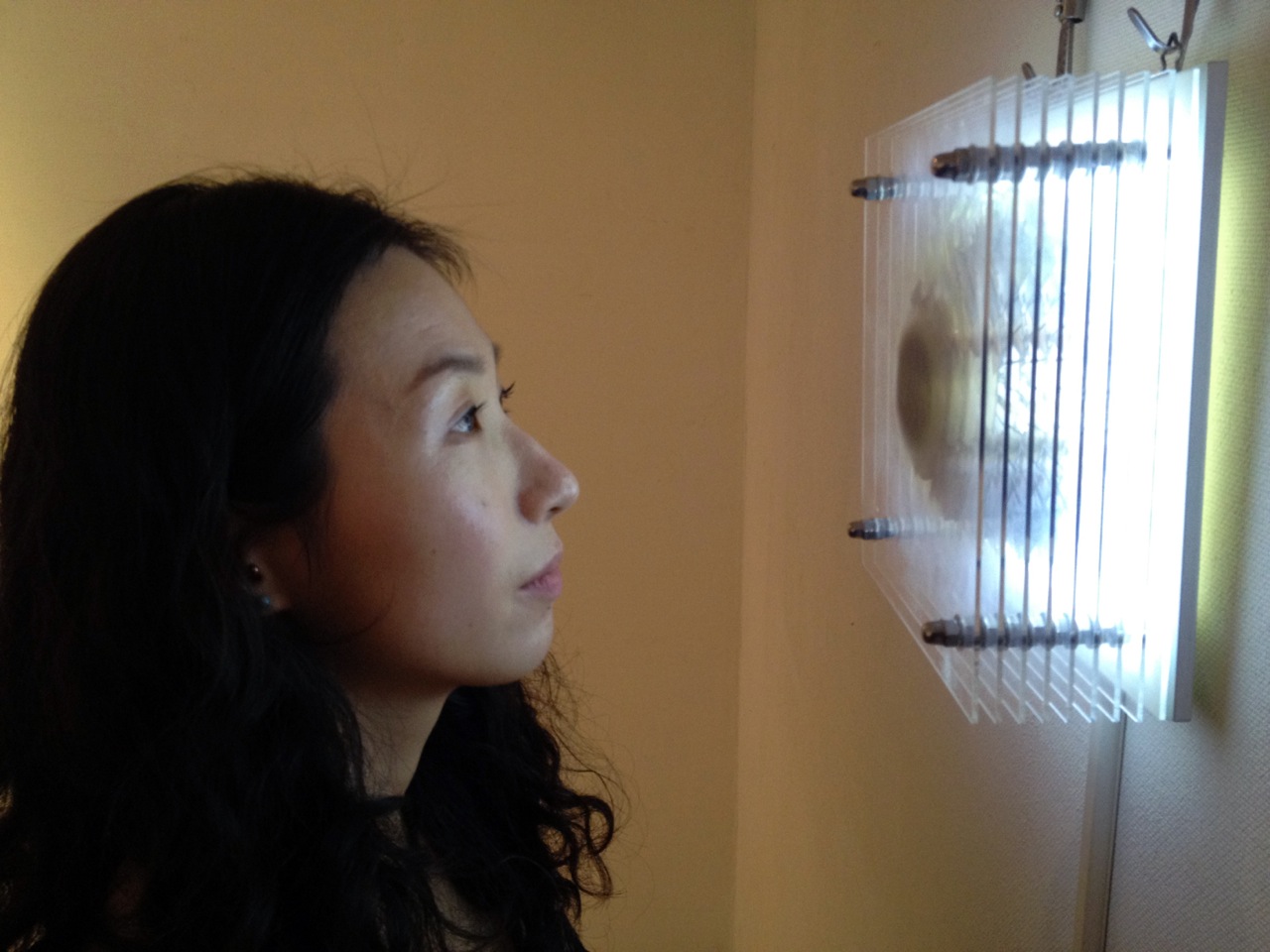
"Initially, I will take a panoramic view of the surrounding area, with a digital camera, working my way around and down in concentric circles, capturing the whole of the environment.  When these images are arranged on a computer, as many as two hundred separate images may be used to construct the final piece.

These are then further broken in to layers of depth, with the furthest items displayed only in the back image, working up to the foreground.  Each layer is then printed on a separate piece acrylic paneling, and these are attached to an LED light box to illuminate the image from the back." 


In my opinion, this is an imaginative and creative process.  This process is also applied to his work with models.  The artist and model Jung Min is the subject of the piece immediately below.


It is a process that requires patience and an eye for detail.  Quality work and quality art cannot be rushed else it will look shoddy and amateurish.  Martyn's father is a model railway enthusiast who takes the time to build just about everything from scratch.  He even builds and solders the electronics necessary to operate the model railway.  I have a feeling that some of that work ethic and knowledge rubbed off onto Martyn.

The acrylic sculpture presented below is titled, Festival Guitar Man.  It illustrates well the detail and workmanship that is required for excellence.


Martyn is quick to praise his wife for the positive influence she has had on him.  She is a graphic designer, and her assistance in buying supplies and contacting factories to produce new or experimental techniques and media is invaluable.  It was she, he candidly admits, who persuaded him to present his best work.  For that reason, he will not substitute quality for cost.  What a wonderful team.

He shared this important and wise advice with me:

"Finding reliable people to work with is an excruciatingly time consuming necessity for any artist.  Whether it be a regular supplier of canvas, a printer or a framer, maintaining these relationships and finding out what good can come does not happen without some epic failures along the way.  Keep trying new places until you until you find what you are looking for."    

Not surprisingly, Martyn stepped back from art when his son was born early in 2012.  Spending time with his son has helped him to mature, and that is pushing his work in a different direction.  Because of the constraints of time and prioritizing what is most important to him, his documentary work is on hold for the time being.

Within the last year, he has been published in PHOTO (ARTVAS), Leaders Magazine, Elle a l'Seoul, Mokpo Today, and the Seoul Art Guide.

I mentioned that Martyn has been involved with music, too.  He played bass guitar for a band called Flying Maru that performed in a number of shows in Seoul.  Listen to some of the music here.

He organized and curated the Homo-Sapiens exhibition earlier this year at Gallery Golmok.  He will curate a show in December 2012 in Insadong at iGallery that will look at man's relationship with animals.

He recently concluded a group exhibit at the Jeonju Biennale.  Early in 2013 he will have his second solo exhibition in Mokpo.

His website can be accessed here.